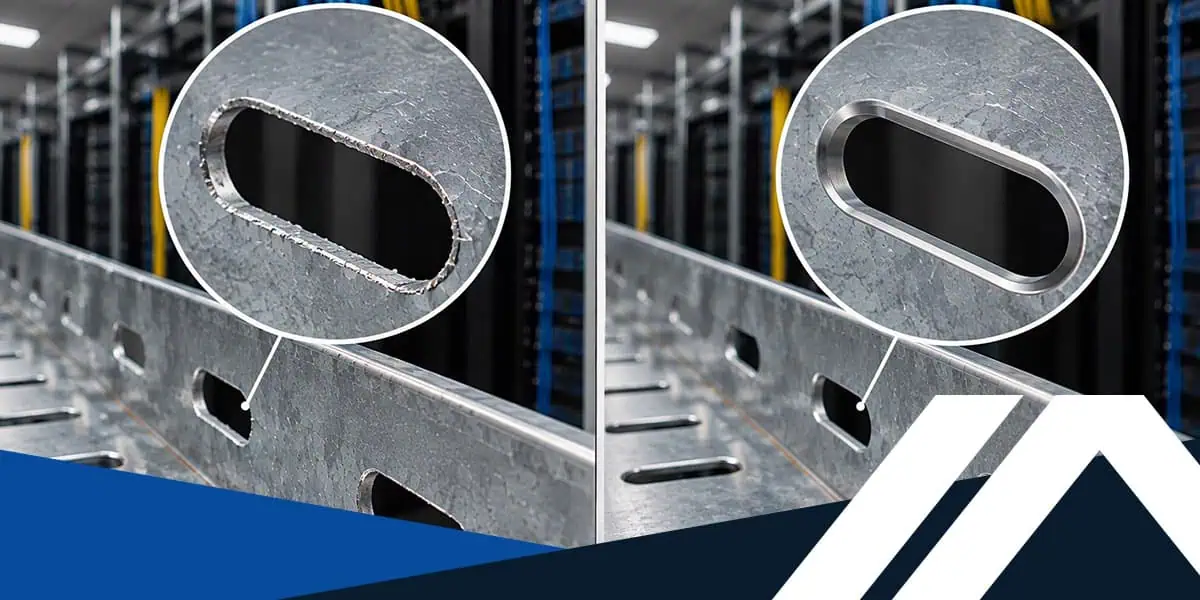
Data centers rely on many precisely finished components, including cable trays, rack frames, enclosures and bus bars, to perform reliably once installed. Each of these parts needs consistent deburring and edge rounding before it reaches the field. Manual deburring for data center components often falls short of that standard, producing slow cycle times, inconsistent edge quality from part to part, coating rework and handling hazards for technicians on the shop floor.
Automated, two-sided finishing addresses these issues by processing parts consistently at the volume data center manufacturing now demands. Understanding what data center deburring involves, how single-pass processing works and how to evaluate whether it fits a given production line gives manufacturers a clear way to raise part quality while keeping pace with growing order volumes.
What Data Center Deburring Involves
Data center deburring refers to a group of related finishing operations, typically performed manually or on a sheet metal deburring machine. It involves removing burrs, smoothing sharp edges and addressing surface imperfections on fabricated components used in data center infrastructure. The right combination for a given part depends on its material, how it was cut and what happens to it downstream, such as coating or assembly.
Most data center deburring processes include these core operations:
- Burr removal: This process eliminates sharp protrusions and leftover tabs from laser cutting, punching, plasma cutting or stamping, including tab removal on parts nested tightly during cutting. It is necessary before any downstream handling, coating or assembly.
- Edge rounding: This step reshapes the cut edge into a controlled radius, going beyond simple burr removal. It matters most before powder coating, e-coating or zinc plating, since sharp edges cause coating to pull back during application and leave bare metal exposed. Achieving a consistent radius across a full production run typically requires dedicated edge rounding equipment rather than manual grinding.
- Dross and oxide removal: This process removes hardened residue left on laser- or plasma-cut edges. Dross on the bottom face of a part can interfere with flat surface seating and coating adhesion.
- Surface preparation: This step scuffs or conditions the surface to improve mechanical bonding for coatings, and it is sometimes combined with deburring in a single pass using multiple head types.
For rack frames in particular, clean edges help preserve fit with EIA-310 rack-mount requirements. For other components, the main benefits include safer handling and more reliable coating adhesion.
Components and Manufacturing Outcomes
Data center electricity consumption is now the primary driver of rising U.S. electricity demand, according to the U.S. Energy Information Administration. That kind of growth means data centers, and the components that go into building them, are being manufactured at a pace few production lines were originally designed to handle. Keeping up requires finishing methods that hold up at volume.
Key components and the finishing outcomes they require include:
- Cable trays: These long, flat sections are typically produced by laser cutting or punching, and burrs along the edges can damage cable insulation during installation, creating a handling hazard for technicians. Consistent cable tray deburring and edge rounding along the full length protects technicians’ safety and maintains a uniform coating along the entire run.
- Rack frames: These structural steel components are built to EIA-310 dimensional standards, so burrs and edge imperfections can throw off mounting tolerances for rack-unit equipment. Server rack deburring keeps those tolerances intact, giving high-volume production runs the assembly consistency needed for parts to fit every time.
- Enclosures and panels: Powder-coated steel or aluminum panels require edge rounding before coating, since pull-back at sharp edges can cause premature corrosion failure at the seam. Properly rounded edges hold coating evenly, supporting a quality finish while reducing rework.
- Brackets and mounting hardware: These parts are often punched or laser-cut in high volume. Unremoved burrs pose handling hazards during assembly and cause fit issues when a burred edge prevents a bracket from seating flush. Clean, uniform edges reduce both risks at once, keeping high-volume runs consistent.
- Bus bars: Made from copper or aluminum, these parts require careful abrasive selection. Aggressive material removal can damage contact surfaces or plating, increasing resistance at connection points. Selecting the right process for the material preserves performance while removing burrs that would otherwise pose a handling risk during installation.
The Role of Top-and-Bottom, Single-Pass Processing
Top-and-bottom, single-pass processing runs a part through a conveyor system, where upper and lower heads simultaneously finish both surfaces. The part comes out finished on both faces in a single trip through the machine.
Two-sided finishing matters most for flat data center components. Cable tray sections, rack panels and enclosure blanks are typically flat, high-volume parts that need both faces finished before coating. Without two-sided capability, an operator has to flip each part and run it through again, doubling handling time and adding variation between passes.
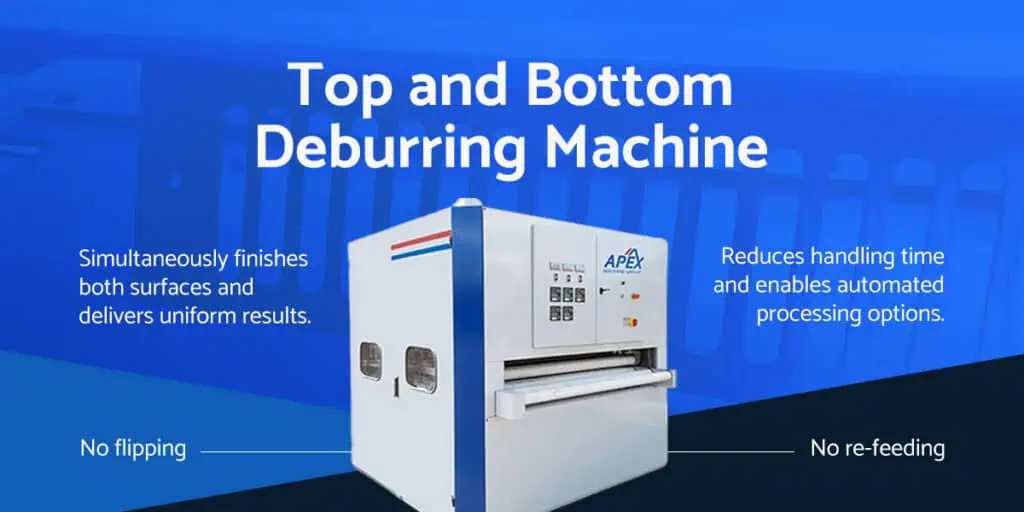
Top-and-bottom deburring machines come in different configurations, and the right one depends on the shop’s parts and volume rather than a single standard setup. Working width can range from about 40 to 100 inches to match different part sizes, and head setups often combine oscillating and rotating sanding discs to deliver uniform results across that width. Some configurations add automatic loading and unloading for higher-volume lines, edge-zone processing for more targeted burr removal or edge chamfering to produce a defined edge angle rather than a rounded one.
Top-and-bottom equipment fits some shops better than others. For instance, a shop running mostly small parts, complex geometries or single-sided finishing may find that a simpler setup works just as well.
Comparing Manual and Automated Finishing Approaches
Deciding between manual and automated finishing requires careful evaluation of various factors in your operation:
- Handling: Manual finishing relies on an operator moving each part by hand across a sanding process, one part at a time. Automated systems move parts through a conveyor, with minimal manual repositioning required from cutting to finished edge.
- Consistency: Manual deburring depends on individual operators’ technique, which can vary across shifts, workers, and even with fatigue late in a shift. Automated processing applies the same finishing parameters to every part, producing the same edge condition.
- Labor dependence: Manual finishing requires skilled operators to be available, trained and consistently staffed across every shift. Automated systems reduce that dependence on manual finishing skills, which matters as the manufacturing workforce faces a shortage that could leave as many as 3.8 million manufacturing jobs unfilled by 2033.
- Capacity: Manual finishing throughput is limited by the number of parts an operator can process by hand per shift. Automated systems can sustain a steady processing rate across a full shift, limited mainly by conveyor speed and part changeovers rather than headcount and operator fatigue.
- Process requirements: Manual finishing can meet a wide range of edge specifications, but accuracy depends on operator skill and attention to detail for a given part. Automated systems maintain a consistent edge condition throughout a full production run, whether that’s a light burr break or a defined coating-ready radius.
What to Consider When Evaluating a Machine
Every shop has different parts, volumes and downstream requirements. Start evaluating a data center deburring machine by looking at your actual parts first, including these production factors:
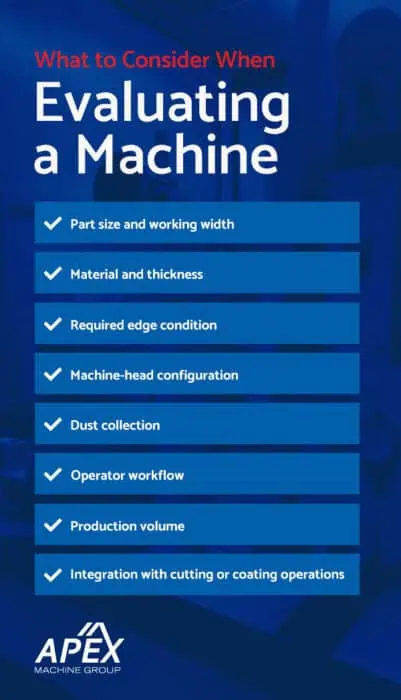
- Part size and working width: Measure the widest part of your typical mix. Cable tray sections and large rack panels can exceed 24 inches, so check that the machine handles your widest standard part in one pass, without trimming or re-orientation.
- Material and thickness: Mild steel, stainless steel, aluminum, galvanized and copper all respond differently to abrasives and need different pressure settings. A sheet metal deburring machine should handle every material in the mix without a lengthy changeover between jobs.
- Required edge condition: Some applications only need safe handling, while others require a defined edge radius for powder coating prep. For example, a light burr break and a 0.5 mm edge radius call for different tooling and settings.
- Machine-head configuration: The right combination of abrasive belts, oscillating discs and rotating brushes depends on burr type and finish requirement. Multi-head configurations handle deburring and edge rounding in a single pass.
- Dust collection: Aluminum dust is combustible and can create fire or explosion hazards when suspended in air. Shops processing aluminum alongside steel need dust collection designed for combustible metal dust and should avoid mixing aluminum dust with ferrous dust in the same collector.
- Operator workflow: How parts are loaded and unloaded affects throughput. Shops should weigh whether their volume justifies automatic loading and unloading or whether a manual-feed conveyor is sufficient.
- Production volume: A machine’s duty rating indicates how many hours it is built to run without excess wear on belts, discs and brushes. Running a lighter-duty machine for continuous multi-shift production results in faster component wear and increased unplanned downtime. Matching the duty rating to your actual shift schedule protects both uptime and tooling life.
- Integration with cutting or coating operations: If your deburring machine will sit between a laser cutter and a powder coat line, check conveyor height, feed speed and part flow direction against your existing setup to determine how well it will fit into the line.
Proving the Fit Before You Invest
Proving the fit before committing to any machine is critical, even if the equipment checks every box on paper. Testing a proposed process against real parts builds confidence that a spec sheet alone cannot provide. The following steps help build that proof before making the final purchase decision:
- Review representative parts: Gather actual parts from current production runs rather than samples pulled for a demo. Record the material, thickness, width and current edge condition for each part, since a machine that handles one material well may struggle with a mixed lineup.
- Define the desired finish: Specify exactly what the finished part needs to look and feel like, whether that is a simple burr-free edge for safe handling, a defined radius for coating preparation or a fully surface-ready condition for powder coating. A vague target like clean edges leads to mismatched equipment recommendations.
- Document the current bottleneck: Track parts per shift under the current process, rework rates after coating and the specific point in the line where finishing slows everything else down. This baseline becomes the standard that any new equipment must improve on, making it possible to measure whether a new machine actually solved the problem.
- Test the proposed process: Send sample parts to a machinery supplier and compare the results directly against the current process, on the same parts, side by side. A test run should reflect the full material and thickness range in production to show how the machine performs on the parts that matter most.
Why Work With Apex Machine Group?
Apex Machine Group specializes in wide-format, multi-head deburring and finishing machines built for high-volume production, including top-and-bottom, single-pass systems for components such as cable trays, rack frames and bus bars. We work directly with shops to match machines to their specific parts. Before recommending a configuration, our team reviews part size, material, required edge condition and production volume, so the equipment gets sized to the parts a shop actually runs.
Rather than building single-purpose machines, we engineer deburring, edge rounding, dross removal and surface preparation into configurable, single-pass systems, so a shop running mixed materials or multiple finish requirements can often cover them on one machine instead of several.
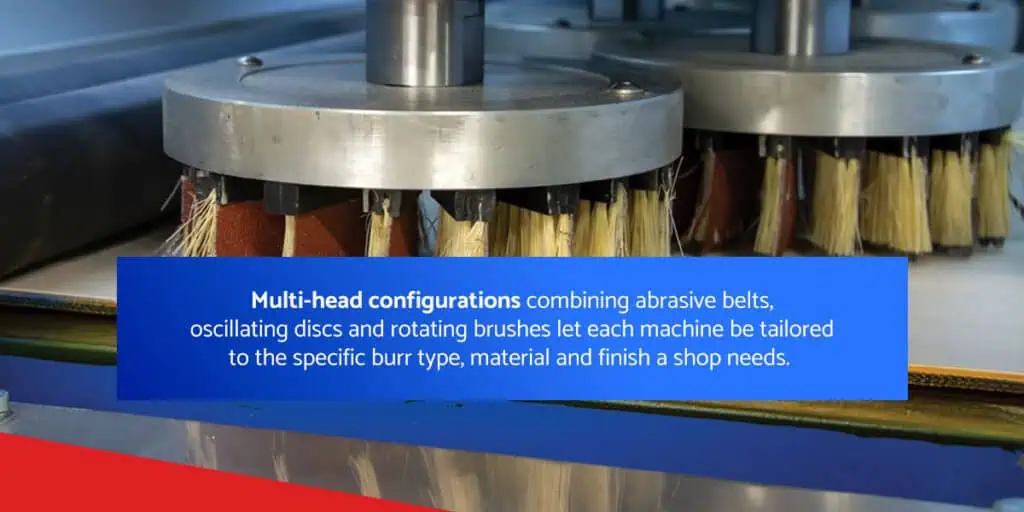
Multi-head configurations combining abrasive belts, oscillating discs and rotating brushes let each machine be tailored to the specific burr type, material and finish a shop needs. We have options suited to various materials, including mild steel, stainless steel, aluminum and copper.
We apply the same application-first approach to the buying process. We can process a set of representative parts before purchase, so your shop can see its own cable trays, rack frames or enclosures finished on the proposed equipment.
Frequently Asked Questions
Here are some answers to common questions manufacturers ask about data center deburring.
Why do cable trays and server rack components need deburring?
Cable trays and server rack components need deburring because they are typically laser-cut or punched from sheet metal, leaving sharp burrs, dross and rough edges on one or both sides. Burrs can damage cable insulation inside trays, create laceration hazards for technicians and cause assembly fit issues in rack frames.
Rough edges also prevent coatings from adhering properly, leading to premature failure. Data center deburring and edge rounding address these issues together, making parts safer to handle, ready for coating and sufficiently consistent to assemble at scale.
What types of data center components can be deburred and finished?
Cable trays, rack frames, enclosures, brackets, panels and bus bars are the most common data center components that require deburring. All of these originate as flat sheet metal parts cut through laser cutting, punching, stamping or plasma cutting. Suitability for automated conveyor-feed finishing depends on part geometry and minimum part size, so shops with very small or unusually shaped parts should confirm fit before committing to a specific machine.
When is single-pass, two-sided deburring a good fit?
Single-pass, two-sided deburring works well for high-volume, flat parts that need consistent finishing on both faces, including cable tray sections, rack panels and enclosure blanks. It is a poor fit for complex 3D geometry, very small parts or low production volume, where setup time outweighs the benefit of finishing both sides in one pass.
What should manufacturers consider when choosing a data center deburring machine?
Manufacturers should weigh working width against their widest parts, since handling oversized parts in multiple passes adds time. Material mix matters too, since aluminum dust requires combustible-metal dust controls and should not be mixed with ferrous dust in the same collector. The required edge condition and production volume both affect tooling choice and machine-head configuration. Finally, the machine needs to integrate cleanly with the existing cutting and coating operations on the line.
Contact Apex Machine Group for Reliable Data Center Deburring
Every data center component has its own materials and specifications, so a machine that works well for one shop’s cable trays may need a different setup for another shop’s rack frames or enclosures. At Apex Machine Group, we start with the specifics before recommending any equipment. Call us at 952-895-1518 for a free consultation or send us your sample parts for a test run.