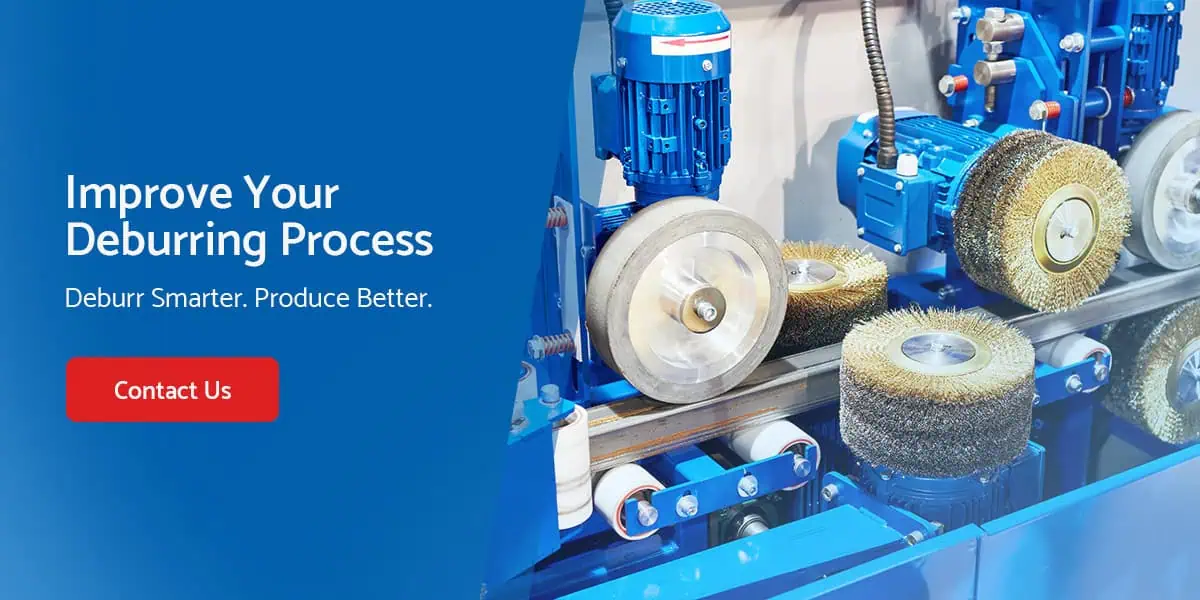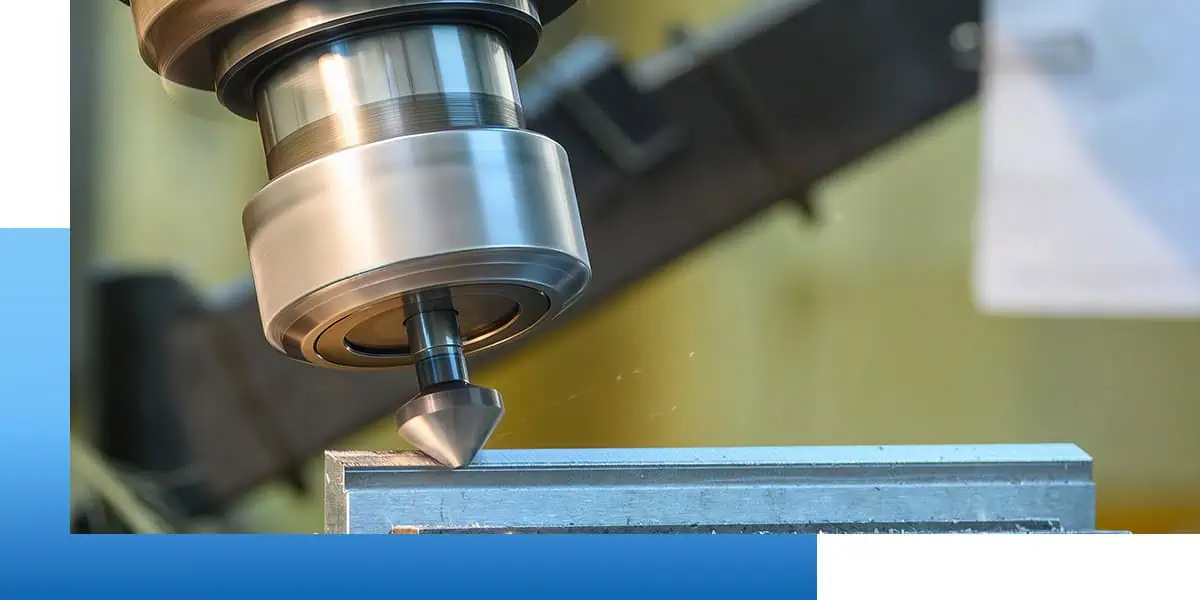
Deburring adds time and cost to production. However, skipping it or performing it inconsistently can create problems downstream. Poor burr removal practices can lead to costly part failures, assembly bottlenecks, dimensional issues, rejected parts, coating failures and safety hazards for both operators and end users.
Manufacturers that focus on process stability, method selection, quality standards and automation can help control costs while improving consistency and throughput.
This practical guide for manufacturers explains how to improve your deburring process and common mistakes to avoid.
1. Stabilize Your Upstream Process First
Start by preventing excessive burr formation. Manufacturers may focus on downstream deburring equipment while overlooking the upstream machining process that generates burrs. Reducing burr size at the source can offer productivity gains.
Several upstream improvements can reduce deburring requirements:
- Implement a proactive tool management program that monitors tool wear and establishes replacement intervals before cutting performance deteriorates.
- Optimize and document machining parameters through controlled testing to identify the ideal speed, feed rate and depth of cut for each material and application.
- Refine computer-aided manufacturing (CAM) programming and toolpath strategies to minimize burr generation on entry and exit points.
- Standardize process settings across shifts and operators to reduce variability.
- Monitor machine condition and spindle performance to prevent vibration and tool deflection that can increase burr formation.
2. Understand Your Material and Part Geometry
Different materials and machining methods produce different burr types. Ductile materials often create long, flexible burrs that smear and fold over edges, while harder materials may produce small but stubborn burrs that can require aggressive removal methods.
Part geometry is equally important. A flat sheet-metal component with open edges can often be processed efficiently with automated equipment. However, parts with intricate contours and complex features may require different technologies to reach all edge locations.
Manufacturers can create an internal process matrix that maps common materials and part types to:
- Preferred deburring method
- Recommended abrasive type
- Edge rounding requirements
- Target cycle times
- Expected surface finish
3. Match Your Deburring Method to Your Volume and Edge Requirements
The best deburring tools and methods depend on production volume, part complexity, edge quality requirements and available labor. Choosing the wrong process can lead to inconsistent quality and production bottlenecks.
Hand Deburring
Hand deburring is valuable for prototyping, low-volume production, custom fabrication and specialty parts. It provides flexibility and allows operators to address unique features that may be difficult to process using automated systems.
However, manual deburring depends on operator skill and can introduce variability from shift to shift. Growing production environments should reserve hand deburring for exceptions rather than relying on it as a primary method.
Vibratory Finishing and Tumbling
Vibratory finishing and tumbling are well-suited for batch processing small components or those with complex geometries. These processes enable efficient handling and finishing of intricate parts.
They are effective for removing light burrs and improving surface finish. Manufacturers producing high volumes of small precision components can use vibratory finishing as an efficient secondary operation.
Wide-Belt Sanding
Wide-belt sanding excels at processing flat sheet-metal components at high volumes. The process quickly removes primary burrs, dross, slag and surface imperfections while maintaining consistent throughput. It is effective for processing plasma-cut, punched, stamped and laser-cut metal parts.
As production requirements increase, manufacturers may transition from manual grinding to automated feed-through systems that combine multiple finishing operations. For example, wet metal machines can integrate abrasive belts, rotating brushes and oscillating discs to simultaneously perform:
- Deburring
- Dross removal
- Slag grinding
- Edge rounding
- Dimensioning
- Finishing
Depending on production requirements, manufacturers can choose systems for job shops, heavier production environments or multi-shift operations. These configurations help reduce labor requirements while improving consistency and throughput.
Nonlinear Brush Technology
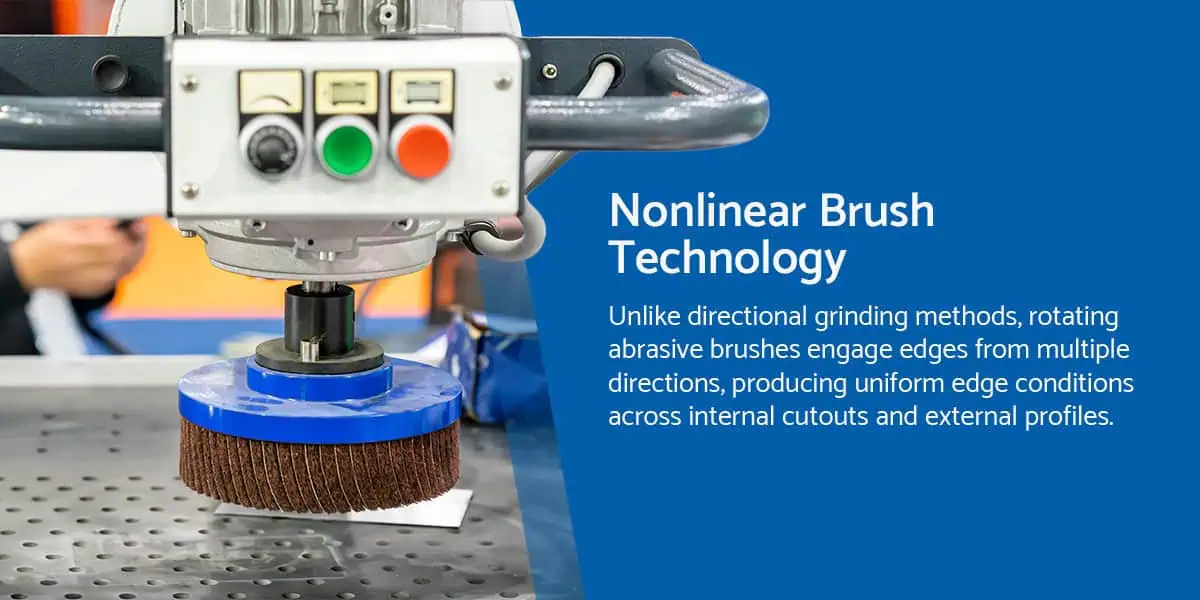
Nonlinear brush technology helps achieve consistent edge rounding. Unlike directional grinding methods, rotating abrasive brushes engage edges from multiple directions, producing uniform edge conditions across internal cutouts and external profiles. This capability is valuable when preparing parts for painting, powder coating or corrosion-resistant finishes.
Consistent edge rounding improves coating adhesion and minimizes sharp edges that can create handling hazards.
Robotic and Automated Deburring
Robotic deburring offers exceptional consistency and process control for complex three-dimensional parts. These systems can maintain precise tool pressure, repeat programmed motions and reduce operator involvement in repetitive finishing tasks.
A practical implementation of automation is found in feed-through systems. Automated finishing equipment combines deburring, edge rounding and surface preparation within a single process. These machines deliver predictable quality and higher throughput.
4. Select the Right Abrasives and Consumables
Even the best machine cannot compensate for poorly selected abrasives. The abrasive performs the actual cutting work, and its characteristics influence edge quality, cycle time, consistency and operating costs.
Common abrasive options include:
- Ceramic and zirconia abrasives are commonly used for stainless steel, hardened materials and demanding production settings where aggressive cutting performance is required. They maintain cutting ability over longer production runs. Because they resist wear and tear, they generally provide the best value for high-volume applications.
- Aluminum oxide abrasives are widely used for general-purpose deburring and finishing applications. They perform well on carbon steel and common fabrication materials while offering an economical balance between cutting performance and consumable cost.
- Silicon carbide abrasives feature a sharp cutting structure that works well on nonferrous materials such as aluminum and brass. Manufacturers may use them for finer surface finishes or to minimize material deformation.
5. Implement Quality Control and Measurement
Burr-free may be interpreted differently by each operator. This lack of objective criteria makes it difficult to consistently control quality standards and can lead to variation. Manufacturers should consider:
- Adopting a formal edge standard: Manufacturers can use the framework established by the International Organization for Standardization (ISO) 13715. The standard provides guidance for defining edge conditions and specifying allowable edge deviations. Adopting formal deburring standards creates a common language between teams, which allows inspection to become objective and repeatable.
- Creating visual workstation standards: Visual standards can improve consistency on the shop floor. Create physical reference boards at each deburring station containing approved limit samples that demonstrate acceptable, unacceptable and ideal edge conditions. Operators can compare production parts against physical examples, improving decision-making.
- Using advanced measurement tools: For critical applications, visual inspection alone may not be sufficient. Edge measurement systems or profilometers can help quantify edge radius and surface finish characteristics.
Common Deburring Process Mistakes to Avoid
Even well-designed deburring processes can create quality and productivity issues when common operational mistakes go unaddressed. Manufacturers should avoid:
- Over-reliance on manual finishing: Manual deburring is useful for prototype and specialty work. Relying on it in high-volume settings can lead to inconsistent edge quality and production bottlenecks.
- Ignoring material properties: Different metals respond differently to cutting and finishing processes. Adjust abrasive selection and edge conditioning methods based on the material being processed.
- Letting upstream processes slip: Worn tooling, unstable machining parameters and poor machine condition can increase burr formation. As a result, downstream deburring operations may have to compensate with additional labor and longer cycle times.
- Skipping in-process inspection: Waiting until final inspection to evaluate edge quality allows defects and inconsistencies to continue through production. Skipping inspection in the middle of the process can increase the risk of large-scale rework and scrap.
Improve Your Deburring Process With Apex Machine Group Solutions
If your current deburring process is creating bottlenecks or quality inconsistencies, the right equipment can help you improve efficiency and achieve predictable results.
Apex Machine Group provides a full range of deburring and finishing solutions. We support applications ranging from general fabrication to high-volume production environments. Our machine configurations can accommodate up to four working heads. They feature abrasive belts, oscillating discs and rotating brushes to remove burrs and slag and prepare surfaces for downstream operations.
We work closely with you to evaluate your production requirements and finishing goals. Our team helps identify an ideal configuration for your operation, ensuring you invest in a custom solution that delivers long-term value and productivity gains.
With over 10 years of experience, application expertise, equipment financing, and ongoing support, we help manufacturers build efficient and scalable deburring processes.
Call us at 952-895-1518 to speak with one of our experts.